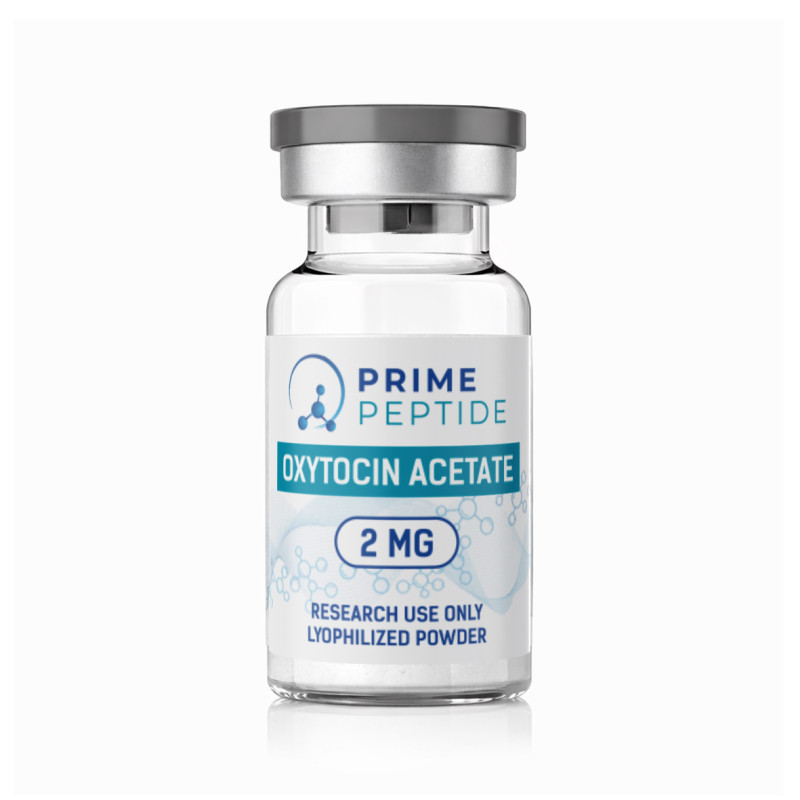
Oxytocin 2mg
Add more to your order:
🧪 Peptide Calculator
What is the total capacity of your syringe?
What is the amount of peptide in the vial?
How much bacteriostatic water will you add?
What is the dose?
What is Oxytocin?
Oxytocin is a peptide hormone that is synthesised in the hypothalamus and released from the posterior pituitary gland. It plays a key role in both physiological processes and the regulation of social behaviour and emotional bonding.
It is often referred to as the “bonding hormone” because it directly contributes to building trust, social connections, and emotional closeness. It is released naturally during social interactions, physical contact, childbirth, and breastfeeding.
Oxytocin acts through specific receptors in the brain and body, influencing neuronal activity, emotional processing, and the stress response. This receptor-mediated mechanism explains its broad effects on behaviour, mood, and physiology.
In addition to its central action, Oxytocin also has peripheral effects, including on uterine contractions and lactation, which makes it one of the best-studied peptide hormones in medicine.
What are the benefits of Oxytocin?
Oxytocin has a complex effect on the brain and behaviour, which makes it unique compared to other peptides.
Improved social interaction
Supports trust, empathy, and the ability to read social cues.
Reducing stress and anxiety
It is associated with lowering cortisol and a calmer response in stressful situations.
Stabilising emotional balance
Affects the way the brain processes emotions and social information.
Improved social communication
It is being studied for its effect on eye contact, emotion recognition, and social engagement.
Supporting a sense of calm
It is often associated with feelings of relaxation and inner balance.
Supporting reproductive processes
It is involved in uterine contractions and in the processes associated with breastfeeding.
Clinical trials on Oxytocin
Oxytocin is one of the best-studied peptide hormones, with data from both medical practice and behavioural sciences.
Classical clinical studies show its role in inducing labour and controlling postpartum bleeding.
In the field of neuroscience, randomised studies suggest that Oxytocin may increase trust in social situations and change the way people assess social risk.
Research into social anxiety shows that the peptide may help process social cues and reduce tension in social environments.
Neuroimaging studies show that Oxytocin affects activity in the amygdala, a key brain structure associated with fear and emotions.
Of particular interest is research into oxytocin in autism spectrum disorders, where effects on social engagement, eye contact, and emotion recognition are observed, although the results vary depending on the protocol.
These data indicate that Oxytocin does not simply act as a “mood hormone”, but as a regulator of complex social and emotional processes.
Correct intake and dosage of Oxytocin within a research protocol
Oxytocin can be administered intranasally or via injection depending on the study objectives.
In research practice, doses in the range of 100 to 500 mcg per application are most commonly used, and with a more moderate approach, dosing starts with lower doses of around 50 to 100 mcg in order to assess the individual response.
In more structured protocols, doses of 100 to 200 mcg per day are used, and if needed, higher doses as well, with administration possibly being once daily or divided.
The duration of protocols is usually between 2 and 6 weeks, and a cyclical approach with breaks to avoid adaptation is often used.
Possible side effects of Oxytocin
Oxytocin is generally considered to be well tolerated, with unwanted reactions that are rare and mild.
Most commonly observed are headaches, nausea, dizziness, or a slight decrease in blood pressure.
In some cases, palpitations, flushing, or temporary mood changes may occur.
In most cases, these reactions are short-lived and subside with adaptation.
Information on this website is collected and summarised from multiple scientific studies and analyses.
It is purely for informational purposes and is not intended for diagnosing, treating, or preventing diseases.
The products offered on the site are not classified as medicines or medical devices and are suitable solely for laboratory and scientific research purposes.
0% Customers recommend this product
- 5 Awesome0%
- 4 Great0%
- 3 Average0%
- 2 Bad0%
- 1 Poor0%
Reviews Over Oxytocin 2mg
- (0)
Total Reviews (0)
click here write review to add review for this product.