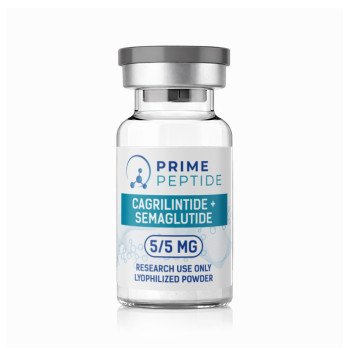
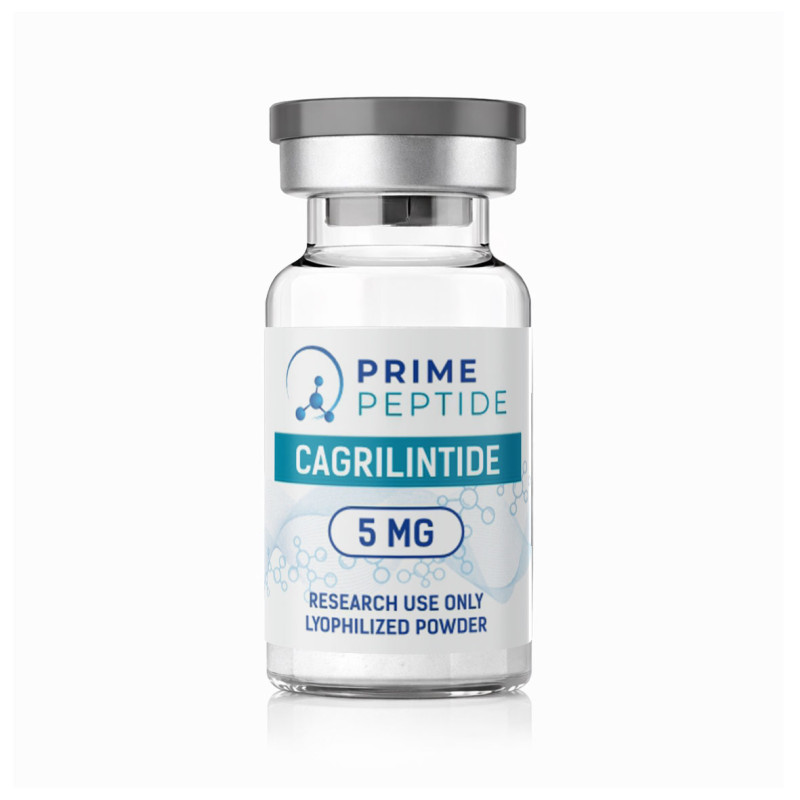
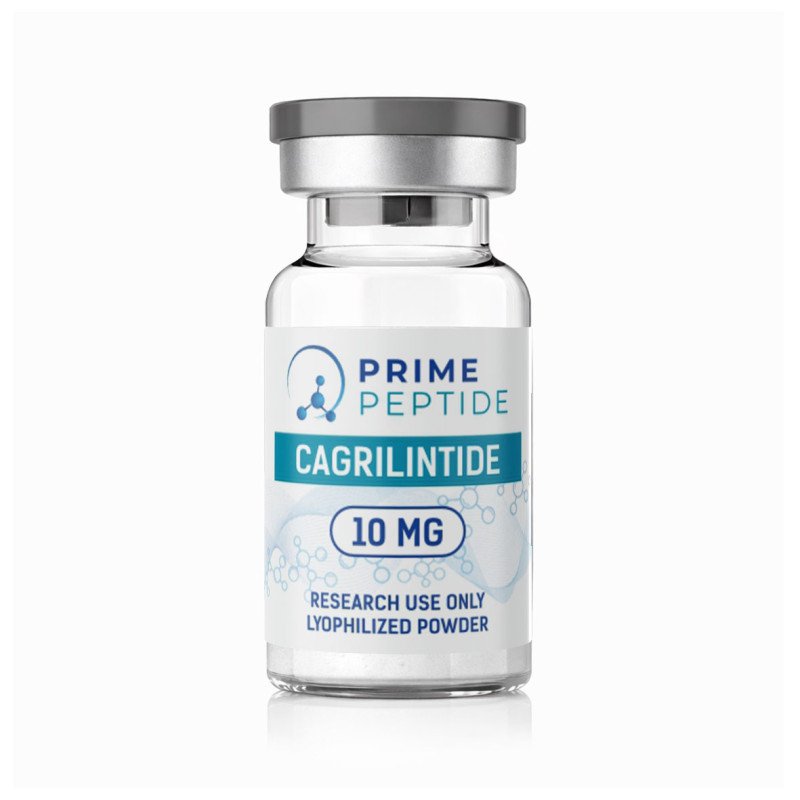
Cagrilintide (Cagrylinetide) 5mg/10mg
This offer ends in:
Available Options
Add more to your order:
🧪 Peptide Calculator
What is the total capacity of your syringe?
What is the amount of peptide in the vial?
How much bacteriostatic water will you add?
What is the dose?
What is Cagrilintide?
Cagrilintide is a long-acting amylin analogue developed and studied mainly for appetite control, food intake, body weight and metabolic health.
Amylin is a natural peptide hormone secreted by the beta cells of the pancreas along with insulin after eating. It plays a role in regulating satiety, the rate of gastric emptying and food intake.
Cagrilintide is designed to have a significantly longer-lasting effect than natural amylin.
The primary interest in Cagrilintide is related to its ability to increase the feeling of fullness and reduce hunger and energy intake. In this way, it is being studied as a potential tool for long-term body weight management.
Unlike GLP-1 receptor agonists such as Semaglutide, Cagrilintide works mainly through amylin receptors. This allows the two mechanisms to be combined, which is the basis for the development of the combination Cagrilintide + Semaglutide.
Clinical studies show a significant reduction in body weight both when studying Cagrilintide alone and when combining it with a GLP-1 receptor agonist.
Cagrilintide remains a research compound and does not have the same regulatory status as established therapies for body weight management.
What are the benefits of Cagrilintide?
Reduced appetite
Cagrilintide is being studied for its ability to enhance satiety signals and reduce the desire to eat.
Support for weight loss
Clinical studies show a significant reduction in body weight with prolonged use of Cagrilintide.
Prolonged feeling of fullness
Through amylin signalling, Cagrilintide affects the mechanisms that regulate the feeling of satiety after eating.
Reduced energy intake
Increased satiety can lead to a lower calorie intake, which is one of the main mechanisms through which Cagrilintide affects body weight.
Long-lasting action
Cagrilintide has been developed as a long-acting analogue, which enables once-weekly dosing to be used in clinical studies.
A different mechanism from GLP-1
Cagrilintide acts primarily on the amylin system, distinguishing it from Semaglutide and Tirzepatide.
Potential for combining with GLP-1
The different mechanisms of action allow Cagrilintide to be studied together with Semaglutide in order to achieve a stronger effect on appetite and body weight.
Supports metabolic health
Weight loss and reduced energy intake may be associated with improvements in various metabolic indicators, which are also tracked in clinical studies.
Clinical trials on Cagrilintide
Cagrilintide has a significantly more advanced clinical programme than many other experimental peptides.
In a Phase 2 clinical study in humans with overweight or obesity, various weekly doses of Cagrilintide were investigated for approximately 26 weeks.
The results show dose-dependent reductions in body weight, and at the highest studied dose of 4.5 mg per week, the average weight loss reaches approximately 10–11%.
A particularly high level of scientific interest is generated by combining Cagrilintide with Semaglutide.
The combination is known as CagriSema and combines two different mechanisms — amylin and GLP-1 receptor signalling.
In clinical programmes, CagriSema is being studied for its potential to achieve a greater reduction in body weight compared with using only one of the components.
Results from later clinical trials show a significant loss of body weight with prolonged use of the combination, confirming the scientific interest in activating these two mechanisms simultaneously.
Proper use and dosage of Cagrilintide
Cagrilintide has no universal approved therapeutic dosage. In clinical trials, specific experimental weekly doses are used, with the amount typically increased gradually.
In Phase 2 studies, the following doses were investigated:
0.3 mg once weekly
0.6 mg once weekly
1.2 mg once weekly
2.4 mg once weekly
4.5 mg once weekly
Doses were administered subcutaneously under controlled clinical conditions.
In combination studies with Semaglutide, a regimen of Cagrilintide 2.4 mg + Semaglutide 2.4 mg once weekly was also investigated.
In clinical protocols, the amount is typically increased gradually rather than starting directly with the highest experimental dose. This allows assessment of tolerability and helps limit gastrointestinal adverse reactions.
The listed 0.3–4.5 mg weekly are experimental doses used in controlled clinical studies, not a universal recommendation for use.
Possible side effects of Cagrilintide
The most commonly observed adverse reactions in clinical studies are associated with the gastrointestinal system.
These include:
nausea;
vomiting;
diarrhoea;
constipation;
abdominal discomfort;
reduced appetite;
a feeling of excessive fullness;
reactions at the site of administration.
Gastrointestinal reactions are usually more pronounced during the initial stages and when increasing the experimental dose.
The long-term safety profile continues to be the subject of clinical research.
Comparison of Cagrilintide with other peptides
Cagrilintide vs Semaglutide
Semaglutide is a GLP-1 receptor agonist, while Cagrilintide is a long-acting amylin analogue. Both mechanisms can reduce appetite and food intake, but they act through different receptor systems. This is precisely the difference that allows them to be combined in CagriSema.
Cagrilintide vs Tirzepatide
Tirzepatide activates both GIP and GLP-1 receptors at the same time. Cagrilintide acts on the amylin system and represents a different approach to regulating satiety and body weight.
Cagrilintide vs Retatrutide
Retatrutide is a triple receptor agonist targeting GLP-1, GIP and glucagon receptors. Cagrilintide has a different and more specific mechanism, based on amylin signalling.
The information on this website is collected and summarised from multiple scientific studies and analyses.
It is purely for informational purposes and is not intended for the diagnosis, treatment or prevention of diseases.
The products offered on the site are not classified as medicines or medical devices and are suitable only for laboratory and scientific research purposes.
0% Customers recommend this product
- 5 Awesome0%
- 4 Great0%
- 3 Average0%
- 2 Bad0%
- 1 Poor0%
Reviews Over Cagrilintide (Cagrilintide) 5mg/10mg
- (0)
Total Reviews (0)
click here write review to add review for this product.