Semaglutide (Semaglutide)










This offer ends in:
What is Semaglutide (Semaglutide)?
Semaglutide is a synthetic peptide from the GLP-1 receptor agonists group that mimics the action of the natural hormone GLP-1. It plays a key role in regulating blood sugar, appetite and energy balance.
Its main advantage is that it works simultaneously on several key mechanisms – it stimulates insulin release when blood sugar is elevated, suppresses glucagon, slows stomach emptying and affects the satiety centres in the brain. This leads to better food control and lower caloric intake.
Semaglutide was originally developed by Novo Nordisk as a long-acting GLP-1 analogue with the possibility of once-weekly administration, which significantly simplifies long-term protocols.
Following successful clinical trials, the peptide was first approved in 2017 for the treatment of type 2 diabetes, and subsequently for weight management. In clinical practice, it is offered under various brand names, with the most popular being Ozempic and Wegovy.
Semaglutide is considered one of the most significant compounds in contemporary research into metabolism and obesity due to its ability to combine appetite, glucose and body composition control within a single mechanism.
What are the benefits of Semaglutide (Semaglutide)?
Semaglutide is one of the most effective peptides for weight control and metabolic balance, because it affects both energy intake and the way the body uses it.
Reducing body weight
The peptide leads to a significant reduction in appetite, which directly lowers caloric intake. As a result, a sustained reduction in body mass is observed, with much of it coming from adipose tissue.
Appetite control
Semaglutide acts on the satiety centres in the brain, which leads to faster feeling of fullness and a less frequent feeling of hunger. This makes sticking to a nutritional regimen significantly easier.
Improving glycaemic control
It stimulates insulin secretion when needed and reduces glucagon release, which results in more stable blood sugar levels.
Slowing stomach emptying
Food stays in the stomach for longer, which extends the feeling of fullness and reduces the frequency of eating.
Improving metabolic markers
Studies show a reduction in blood pressure and triglycerides and an improvement in glucose metabolism.
Supporting cardiovascular health
It is associated with improvements in key risk factors such as weight, glucose and lipid profile, which are directly relevant to cardiovascular risk.
Clinical trials on Semaglutide (Semaglutide)
Semaglutide is one of the best-studied GLP-1 analogues with large-scale clinical programmes.
In the SUSTAIN programme, aimed at type 2 diabetes, it has been observed that there is a significant reduction in HbA1c, improvement in glycaemic control and a concurrent reduction in body weight.
In the STEP programme, focused on weight management, the results are even more impressive, with an average reduction in body weight of around 10 to 15 per cent, and in some participants, even more with long-term use.
Additional clinical analyses show that Semaglutide may reduce the risk of cardiovascular events in patients with type 2 diabetes.
These results place it among the most effective compounds studied for obesity, metabolic syndrome and insulin resistance.
Proper use and dosage of Semaglutide (Semaglutide) within a research protocol
Semaglutide is administered via subcutaneous injection once a week, with the dose increased gradually over intervals of 4 weeks, starting from 0.25 mg, then 0.5 mg and 1 mg, and, if necessary and well tolerated, it may reach up to 1.7 mg or 2.4 mg per week.
The duration of the protocol is typically a minimum of 8 to 12 weeks; for a more pronounced effect it is often applied in the range of 12 to 24 weeks, and gradual dose titration is key for better tolerability and minimising side effects.
Possible side effects of Semaglutide (Semaglutide)
Semaglutide is considered a relatively well-tolerated peptide, with side effects most often associated with the gastrointestinal system.
Most common:
- nausea
- vomiting
- diarrhoea
- constipation
- decreased appetite
Less common:
- abdominal pain
- headache
- dizziness
- stomach discomfort
In most cases, symptoms appear at the beginning and decrease as you adapt to the dose.
Faster dose escalation significantly increases the risk of adverse reactions, which is why a gradual approach is used.
The information on this website has been collected and summarised from multiple scientific studies and analyses.
It is purely for informational purposes and is not intended for diagnosis, treatment or prevention of diseases.
The products offered on the site are not classified as medicines or medical devices and are suitable only for laboratory and scientific research purposes.


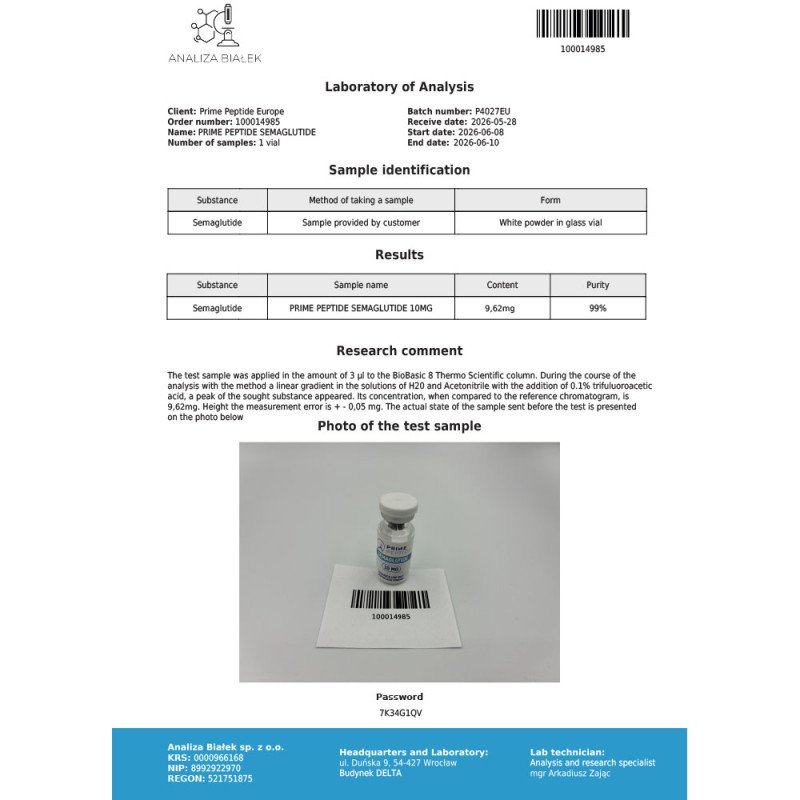
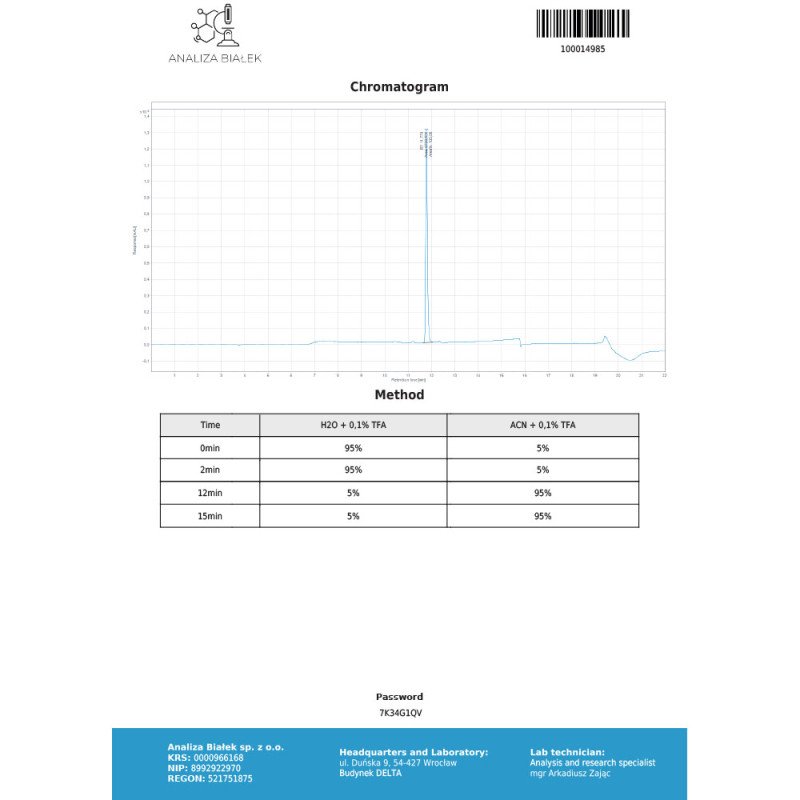
Check the authenticity of this certificate through the official website of the independent laboratory Analiza Bialek.