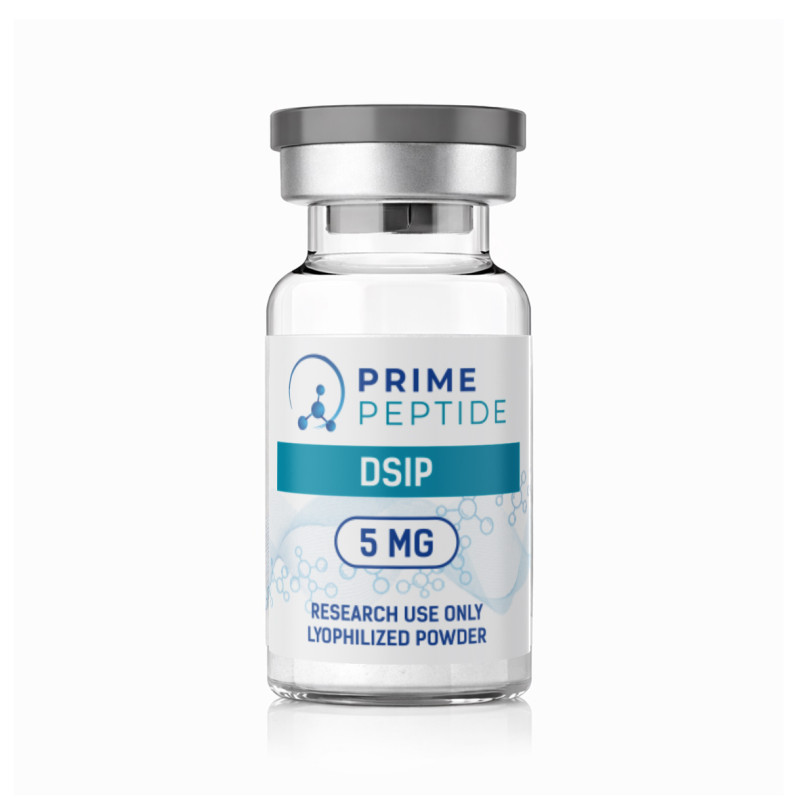
DSIP (Delta Sleep Inducing Peptide) 5mg
Add more to your order:
🧪 Peptide Calculator
What is the total capacity of your syringe?
What is the amount of peptide in the vial?
How much bacteriostatic water will you add?
What is the dose?
What is DSIP?
DSIP (Delta Sleep Inducing Peptide) is a neuropeptide discovered in the 1970s in research related to sleep and brain activity. Its name comes from its ability to influence the delta phase of sleep – the deepest and most restorative stage in which the body actually regenerates.
The peptide acts at the level of the central nervous system, participating in the neurochemical processes that regulate falling asleep, sleep depth and the overall balance of the nervous system. It is believed to affect the neurotransmitters and pathways in the brain that are responsible for sleep and the response to stress.
Besides sleep quality, DSIP is also being investigated for its effect on cortisol levels, adaptation to stress, the immune system and overall recovery of the body. That is why it is considered not simply a peptide for sleep, but a factor that supports overall regulation and balance in the body.
What are the benefits of DSIP?
Improving deep sleep
DSIP helps facilitate entry into the delta phase, which is most important for recovery.
Faster sleep onset
Supports the natural process of falling asleep and regulates sleep.
Reducing stress and anxiety
It is associated with better control over cortisol and the nervous system.
Improved recovery
Better sleep leads to faster physical and mental regeneration.
Regulation of the circadian rhythm
Helps synchronize the internal biological clock.
Support for the nervous system
Affects neurotransmitters and brain function.
Improving concentration and memory
It is associated with better cognitive function with quality sleep.
Potential influence on chronic pain
Being studied for effects in conditions related to stress and pain.
Support for the immune system
Associated with improved adaptation and resilience of the body.
Clinical trials on DSIP
DSIP is the subject of various studies related to sleep, neurology and the body's stress response. Data show that the peptide may positively affect the duration and depth of sleep, increasing the time spent in the most restorative phases.
Some observations also report a reduction in stress, improvement in overall condition and effects on hormones related to sleep. Studies also examine its potential action on the nervous system, cognitive functions and the body's adaptation to stress and workload.
Although the scientific data are still evolving, interest in DSIP remains high because of its unique role in the regulation of sleep.
Proper administration and dosing of DSIP within a research protocol
DSIP is usually administered via subcutaneous injection, with the most commonly used doses in research protocols ranging from 250 to 450 mcg per day. It is usually administered in the evening, about 30 to 60 minutes before sleep, to coincide with the body's natural processes.
Administration is often cyclical, with duration varying from a few weeks to about two months, followed by a rest period. The exact approach depends on the study goals and individual response.
Possible side effects of DSIP
DSIP is usually well tolerated, with the most commonly observed effects being mild and short-lived such as drowsiness, fatigue or headache, especially at the start of administration. In rare cases there may be changes in sleep or mild hormonal fluctuations.
As with any bioactive peptide, the response is individual, but in most cases the effects are temporary and mild.
Comparison of DSIP with other peptides
DSIP belongs to the group of neuroregulatory peptides and is mainly associated with sleep, stress adaptation and recovery of the nervous system. Unlike peptides aimed at growth hormone or muscle growth, its focus is on sleep quality and the balance of the nervous system.
DSIP vs Selank
Selank is a neuroregulatory peptide with a stronger focus on anxiety, tension, emotional balance and cognitive stability. DSIP is more directed towards sleep and night-time recovery, while Selank is more suitable for daytime stress, tension and nervous overload. In short, DSIP works more on sleep, and Selank on calmness and mental balance.
DSIP vs Semax
Semax is a nootropic peptide associated with focus, memory, concentration, neuroprotection and mental productivity. DSIP acts in the opposite direction – it does not stimulate brain activity, but supports deep recovery and normalization of sleep. Semax is a more daytime functional peptide, while DSIP is an evening recovery peptide.
DSIP vs Epitalon
Epitalon is a bioregulatory peptide with a broader anti-aging profile, associated with telomeres, circadian rhythm, cellular age and longevity. DSIP is a narrower and functional tool for sleep, the nervous system and stress recovery. Epitalon is a more systemic longevity approach, while DSIP is a more practical sleep-recovery approach.
The information on this website has been gathered and summarized from numerous scientific studies and analyses.
It is entirely informational in nature and is not intended for diagnosis, treatment or prevention of diseases.
Products offered on the site are not classified as medicines or medical devices and are intended solely for laboratory and scientific research purposes.
0% Customers recommend this product
- 5 Awesome0%
- 4 Great0%
- 3 Average0%
- 2 Bad0%
- 1 Poor0%
Reviews Over DSIP (Delta Sleep Inducing Peptide) 5mg
- (0)
Total Reviews (0)
click here write review to add review for this product.