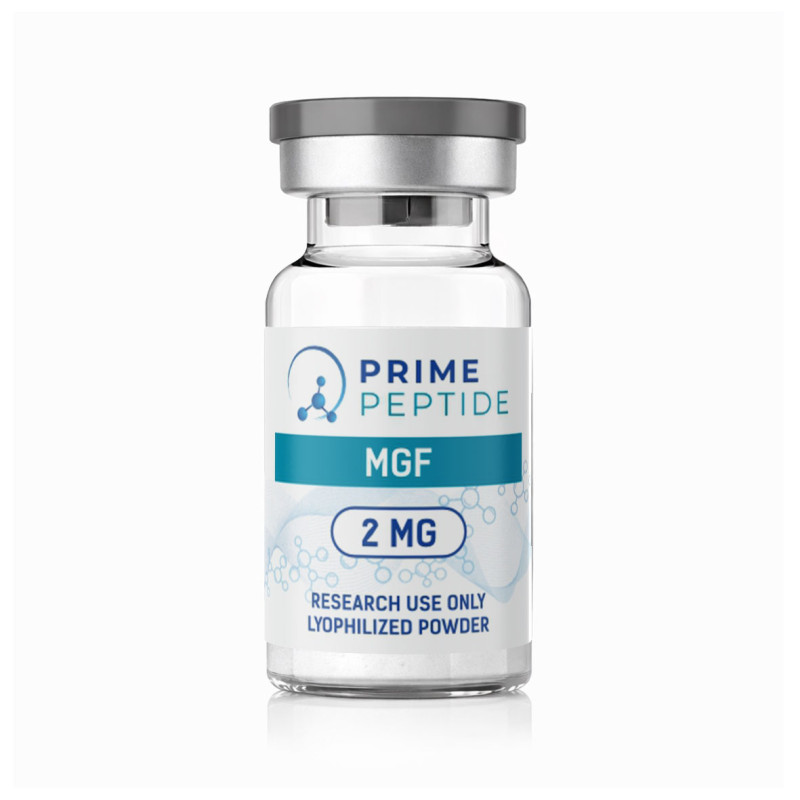
MGF 2mg
🧪 Peptide Calculator
What is the total capacity of your syringe?
What is the amount of peptide in the vial?
How much bacteriostatic water will you add?
What is the dose?
What is MGF?
MGF (Mechano Growth Factor) is a name used for a mechanosensitive variant of IGF-1 (Insulin-like Growth Factor-1), associated with the local response of skeletal muscle to mechanical loading and tissue damage.
MGF is of interest in sports and cellular physiology due to the role of IGF-1 splicing variants in the processes that occur after physical exertion. After mechanical stress in muscle tissue, changes are observed in the local expression of IGF-1, which are linked to recovery and adaptation processes.
One of the main areas of research is the effect on muscle satellite cells. These are cells involved in recovery, regeneration and adaptation of skeletal muscle after injury or intense exertion.
MGF is studied in relation to the activation and proliferation of these cells, which is why the compound is of interest in experimental models of muscle regeneration, hypertrophy and recovery after mechanical stress.
Its mechanism is linked to the IGF-1 system, but the biological profile of locally expressed IGF-1 variants should not be considered identical to that of circulating IGF-1.
In the research environment, both MGF and PEG-MGF are encountered. PEG-MGF is a pegylated synthetic variant developed with the aim of longer-lasting stability and exposure. The two forms are not identical and should be considered separately.
MGF is not approved as a medicinal product by the FDA or EMA and is used mainly for laboratory and research purposes.
What are the benefits of MGF?
Muscle regeneration
MGF is studied for its role in the local mechanisms activated after mechanical loading and muscle tissue damage.
Activation of satellite cells
One of the main areas of scientific interest is the potential influence on the activation and proliferation of muscle satellite cells.
Supporting muscle growth
MGF is of interest when investigating the cellular mechanisms through which skeletal muscle adapts to physical exertion.
Recovery after exertion
Changes in local IGF-1 signalling after mechanical stress are linked to recovery and remodelling processes in muscle tissue.
Cellular proliferation
MGF is studied in relation to the processes that regulate the proliferation of muscle progenitor and satellite cells.
Tissue repair
Scientific interest is not limited solely to muscle hypertrophy, but also includes the mechanisms of recovery after tissue injury.
Adaptation to mechanical stress
MGF is particularly of interest as part of the molecular response of muscle tissue to mechanical loading.
Research into muscle atrophy
IGF-1 signalling mechanisms and their local variants are also studied in models associated with loss of muscle mass and impaired regeneration.
Clinical trials on MGF
The scientific literature on MGF is focused mainly on cellular, molecular and preclinical models, as well as on the investigation of the natural expression of IGF-1 splicing variants in human muscle tissue.
Studies show that mechanical loading can change the expression of certain IGF-1 transcripts in skeletal muscle. This supports the concept of a local mechanosensitive response involved in muscle adaptation processes.
In experimental models, MGF-related peptide sequences have been studied for their effects on the proliferation and behaviour of muscle cells.
There are also preclinical studies on the regenerative mechanisms in muscle and other tissues.
Proper intake and dosage of MGF
There is no officially established or approved therapeutic dosage for MGF in humans.
In various experimental and unofficial research protocols, amounts are often found in the approximate range of 100–400 mcg, with the commonly discussed range being around 200–300 mcg per experimental exposure.
The following approximate research ranges are also encountered:
100–200 mcg – low experimental range;
200–300 mcg – medium experimental range;
300–400 mcg – higher experimental range.
In unofficial research/community protocols, MGF is often associated with investigating the period immediately after mechanical loading, as the natural expression of MGF-related IGF-1 variants is considered part of the early local response of muscle tissue.
Experimental periods of approximately 2–4 weeks are also reported, but there is no clinically established standard for quantity, frequency or duration.
MGF and PEG-MGF should not be dosed or treated as identical substances, as pegylation changes the molecule’s pharmacokinetic characteristics.
Possible side effects of MGF
Due to the lack of sufficient controlled clinical trials, the safety profile of synthetic MGF in humans has not been established.
The potential adverse reactions discussed in relation to IGF-related signalling mechanisms and experimental peptides may include:
local redness or irritation;
headache;
dizziness;
fluid retention;
changes in glucose metabolism;
potential adverse effects related to stimulation of cellular growth.
The last point is especially important for compounds that interact with mechanisms of cell proliferation and growth. The long-term safety profile of MGF has not been established.
Comparison of MGF with other peptides
MGF vs PEG-MGF
PEG-MGF is a pegylated form of MGF, developed to increase stability and the duration of exposure. MGF is a non-pegylated form and is characterised by shorter stability. The two forms should not be considered interchangeable.
MGF vs IGF-1 LR3
IGF-1 LR3 is a modified IGF-1 analogue with extended action and strong interaction with the IGF-1 receptor system. MGF is associated with a mechanosensitive IGF-1 splicing variant and is of interest mainly for the local processes of muscle adaptation and regeneration.
MGF vs CJC-1295
CJC-1295 acts on the GHRH receptor system and is studied for stimulating endogenous growth hormone secretion. MGF is not a GH secretagogue and is linked to the local IGF-1 system and the response to mechanical loading.
MGF vs Growth Hormone (HGH)
Growth Hormone (HGH) has systemic activity and stimulates the production of IGF-1 in various tissues. MGF is viewed as part of the local IGF-1 response to mechanical stress and has a different biological profile.
Information on this website is compiled and summarised from multiple scientific studies and analyses.
It is for purely informational purposes and is not intended for diagnosing, treating or preventing diseases.
The products offered on this site are not classified as medicines or medical devices and are suitable only for laboratory and research purposes.
0% Customers recommend this product
- 5 Awesome0%
- 4 Great0%
- 3 Average0%
- 2 Bad0%
- 1 Poor0%
Reviews Over MGF (Mechano Growth Factor) 2mg
- (0)
Total Reviews (0)
click here write review to add review for this product.