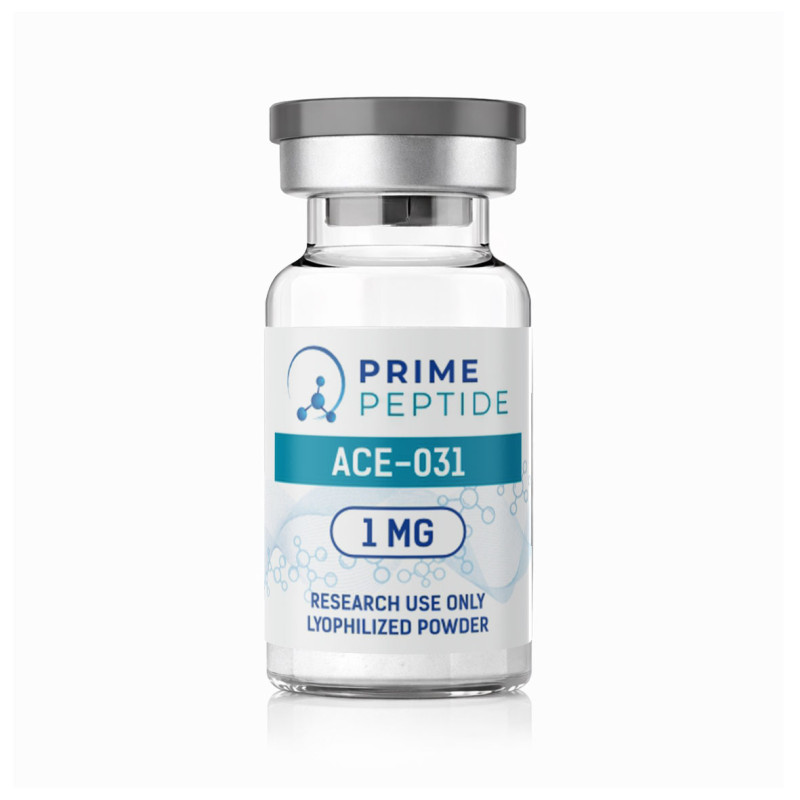
ACE-031 1mg
🧪 Peptide Calculator
What is the total capacity of your syringe?
What is the amount of peptide in the vial?
How much bacteriostatic water will you add?
What is the dose?
What is ACE-031?
ACE-031 is an experimental biological agent, developed to influence the signalling mechanisms that limit the growth of skeletal muscle. It represents a soluble form of the activin receptor type IIB (ActRIIB), linked to an Fc fragment, and functions as a so-called “ligand trap”.
The main interest in ACE-031 is related to its interaction with myostatin (GDF-8) – a natural protein that acts as a negative regulator of muscle growth. Myostatin sends signals to muscle cells that limit excessive increases in muscle tissue.
ACE-031 binds to myostatin and other ligands that normally activate the ActRIIB receptor. In this way, the possibility of reducing the signals that limit muscle growth is studied, and correspondingly increasing net muscle mass.
Importantly, ACE-031 is not a classic peptide for stimulating growth hormone and does not act directly through the GH/IGF-1 axis. Its mechanism is different and is targeted mainly at ActRIIB signalling and factors from the TGF-β family.
ACE-031 was initially developed as a potential therapeutic agent for diseases characterised by the loss or insufficient development of muscle tissue. Preclinical and early clinical studies were conducted, including in Duchenne muscular dystrophy.
Due to its potential influence on muscle mass, ACE-031 is of significant interest in research on muscle physiology, sarcopenia, muscle atrophy, body composition, and the mechanisms that control the growth of skeletal muscle.
ACE-031 has not been approved as a medicinal product by the FDA or EMA and is used mainly in scientific and research settings.
What are the benefits of ACE-031?
Increase in muscle mass
ACE-031 is being studied for its ability to increase net muscle mass by limiting certain signals that suppress muscle growth.
Inhibition of myostatin signalling
Binding to myostatin and other ActRIIB ligands may reduce signals that naturally limit the development of skeletal muscle.
Support in muscle atrophy
ACE-031 has been studied in the context of diseases and experimental models characterised by loss of muscle mass.
Potential increase in muscle strength
By increasing muscle mass, ACE-031 is also being investigated for a potential effect on muscle function and physical strength.
Improved body composition
In scientific models, the potential of ActRIIB blockade to change the ratio between lean body mass and fat mass is being studied.
Support for muscle development
ACE-031 is of interest in research into the mechanisms that regulate the size, growth, and adaptation of muscle fibres.
Research in sarcopenia
Its mechanism is of interest in studies of age-related loss of muscle mass and function.
Research in muscular dystrophies
ACE-031 has been studied as an experimental candidate in diseases characterised by progressive loss of muscle tissue, including Duchenne muscular dystrophy.
Clinical trials on ACE-031
ACE-031 has undergone preclinical studies and early clinical trials in humans, which distinguishes it from a number of experimental compounds for which mainly laboratory or animal data exist.
In an early clinical study in healthy postmenopausal women, an increase in lean body mass was observed following administration of ACE-031. The results support the hypothesis that blocking ActRIIB signalling may measurably affect muscle tissue in humans.
ACE-031 was subsequently studied in boys with Duchenne muscular dystrophy – a genetic disease characterised by progressive weakness and loss of muscle tissue.
Early results indicate biological activity of the compound and changes in markers related to muscle mass. However, the clinical development of ACE-031 was discontinued after unwanted effects were observed in studies, including nosebleeds and the expansion of small superficial blood vessels.
This highlights the fact that the ActRIIB signalling pathway is involved not only in the regulation of muscle tissue, but also in other physiological processes.
For this reason, ACE-031 continues to be of interest as a research compound for studying myostatin signalling, muscle hypertrophy, and the mechanisms regulating muscle mass, but there is no approved therapeutic use.
Correct intake and dosage of ACE-031
No established or approved therapeutic dosage exists for ACE-031, as the compound remains experimental and has not been approved for medical use.
In a clinical study in healthy volunteers, ACE-031 was administered subcutaneously as a single experimental dose in the range of 0.02 to 3 mg/kg of body weight.
At the highest tested single dose of 3 mg/kg, an average increase in lean body mass of approximately 3.3% was reported, as well as an increase in the volume of the thigh musculature by approximately 5.1% on day 29.
In another clinical study in patients with Duchenne muscular dystrophy, the following experimental dosing regimens were used:
0.5 mg/kg subcutaneously once every 4 weeks for a period of 12 weeks;
1 mg/kg subcutaneously once every 2 weeks for a period of 12 weeks.
A subsequent group with a dose of 2.5 mg/kg once every 4 weeks was planned and followed, but participants did not receive this regimen because the study was stopped before including that group based on preliminary safety data.
The quantities stated are entirely experimental doses, used in controlled clinical research. They do not constitute a recommendation for intake, a therapeutic schedule, or an established safe dosage.
ACE-031 has a prolonged pharmacokinetic profile; in the early study an average half-life of approximately 10–15 days was reported. Due to limited data and the discontinued clinical development at present, no standard has been established for an optimal dose, frequency, or duration of administration outside controlled scientific studies.
Possible side effects of ACE-031
Data from early clinical studies show that ACE-031 may cause adverse reactions.
Among the reported effects are:
nosebleeds (epistaxis);
expansion of small superficial blood vessels (telangiectasias);
reactions at the site of administration;
headache;
potential changes related to vascular function.
The observed vascular adverse reactions are important, as ACE-031 interacts not only with myostatin. ActRIIB is involved in the signalling of several different ligands, which means that blocking this pathway may have effects beyond skeletal muscle.
The long-term safety profile of ACE-031 has not been established.
Comparison of ACE-031 with other peptides
ACE-031 vs Follistatin-344
Both compounds are studied in relation to myostatin signalling and muscle growth. Follistatin-344 is a form of follistatin that binds activins and other members of the TGF-β family, whereas ACE-031 is a soluble ActRIIB receptor complex that functions as a ligand trap. Their mechanisms partially overlap, but they are not identical.
ACE-031 vs IGF-1 LR3
IGF-1 LR3 is an analogue of IGF-1 and is directly linked to signalling mechanisms involved in cellular growth, protein synthesis, and anabolic processes. ACE-031 works through a different mechanism – by limiting signals that suppress muscle growth.
ACE-031 vs CJC-1295
CJC-1295 is an analogue of GHRH, studied for its ability to stimulate growth hormone secretion and the resulting increase in IGF-1. ACE-031 does not directly stimulate GH secretion, but acts on ActRIIB signalling and the mechanisms associated with myostatin.
ACE-031 vs Growth Hormone (HGH)
Growth Hormone (HGH) has broad systemic effects and influences IGF-1, protein metabolism, recovery, and body composition. ACE-031 is not a growth hormone and does not act through direct activation of the GH/IGF-1 axis. The main scientific interest in it is related to limiting ActRIIB-mediated signals that regulate muscle growth.
The information on this website is collected and summarised from multiple scientific studies and analyses.
It is purely for informational purposes and is not intended for diagnosing, treating, or preventing diseases.
The products offered on the site are not classified as medicines or medical devices and are suitable only for laboratory and scientific research purposes.
0% Customers recommend this product
- 5 Awesome0%
- 4 Great0%
- 3 Average0%
- 2 Bad0%
- 1 Poor0%
Reviews Over ACE-031 1mg
- (0)
Total Reviews (0)
click here write review to add review for this product.