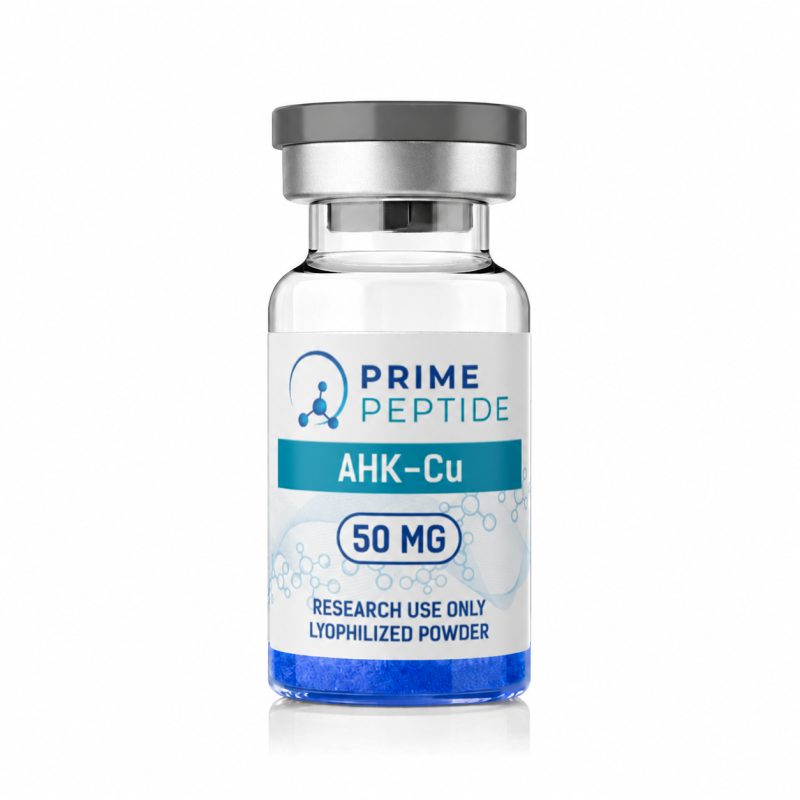
AHK-Cu 50mg
🧪 Peptide Calculator
What is the total capacity of your syringe?
What is the amount of peptide in the vial?
How much bacteriostatic water will you add?
What is the dose?
What is AHK-Cu?
AHK-Cu (Alanine-Histidine-Lysine Copper) is a copper tripeptide composed of three amino acids – alanine, histidine and lysine – bound to a copper ion (Cu²⁺). It belongs to the group of copper-binding peptides and is mainly studied for its potential influence on hair follicles, skin, collagen synthesis and tissue regeneration processes.
Copper is an important trace element and a cofactor of a number of enzymes involved in the formation and stabilisation of connective tissue, antioxidant protection and various cellular processes. Binding it to the AHK peptide allows the formation of a complex that is of interest as a biologically active signalling molecule.
One of the most interesting areas of research on AHK-Cu is hair growth. Laboratory studies on human hair follicles examine the ability of AHK-Cu to stimulate hair follicle elongation and the proliferation of dermal papilla cells – cells with a key role in regulating the hair cycle.
AHK-Cu is also studied in relation to fibroblast activity, collagen and elastin synthesis, and remodelling of the extracellular matrix. These mechanisms make it of interest for scientific models related to skin ageing, regeneration and tissue repair.
AHK-Cu is often compared to GHK-Cu. Although both are copper tripeptides, their amino acid sequence is different and they should not be regarded as identical compounds.
AHK-Cu is not approved as a medicinal product by the FDA or EMA and is used mainly in laboratory and research settings.
What are the benefits of AHK-Cu?
Support for hair growth
AHK-Cu is being studied for its potential influence on human hair follicles and the mechanisms that control hair growth.
Stimulation of dermal papilla cells
Laboratory data show an effect on the proliferation of dermal papilla cells, which have an important role in regulating the hair cycle.
Support for hair follicles
AHK-Cu is of interest in research into cellular mechanisms related to the activity and maintenance of hair follicles.
Support for collagen synthesis
Copper peptides are being studied in connection with processes involved in the formation and remodelling of the collagen structure.
Improving skin condition
AHK-Cu is of interest in anti-ageing research related to the elasticity, structure and restoration of the skin.
Tissue regeneration
The peptide is being studied for its potential influence on cellular regeneration and tissue repair processes.
Support for fibroblast activity
Fibroblasts are involved in the production of collagen, elastin and other components of the extracellular matrix. AHK-Cu is of interest in research into their activity.
Support for connective tissue
Copper is involved as a cofactor in enzymes related to the structure and stability of collagen and elastin.
Anti-ageing potential
The combination of effects on collagen, cellular regeneration and the extracellular matrix makes AHK-Cu a subject of interest in research on skin ageing.
Clinical trials on AHK-Cu
Scientific data on AHK-Cu are significantly more limited compared with established medicinal substances, and much of the available information comes from laboratory and ex vivo studies, rather than from large-scale clinical trials in humans.
Experiments with human hair follicles are of particular interest, in which AHK-Cu has been studied for its influence on follicle growth and the activity of dermal papilla cells.
The results from such laboratory models are the reason AHK-Cu is considered potentially interesting in research into hair loss, the hair cycle, and hair follicle biology.
Another main focus is the mechanisms related to copper peptides and their interaction with fibroblasts, collagen and the extracellular matrix.
However, to date there are insufficient large-scale controlled clinical trials to establish therapeutic efficacy, optimal dosage and a long-term safety profile of AHK-Cu in humans.
Therefore, laboratory results should not be interpreted as evidence of an approved therapeutic use.
Proper intake and dosage of AHK-Cu
There is no officially established or approved therapeutic dosage for AHK-Cu. The published scientific data are mainly from in vitro and ex vivo models; therefore, the quantities described below should be considered only as experimental research protocols, not as a medical recommendation.
Example experimental protocol
In unconfirmed research and community protocols for AHK-Cu, quantities are encountered approximately in the range:
- 250–500 mcg – a low experimental range;
- 0,5–1 mg – a medium experimental range;
- 1–2 mg – a higher experimental range.
As an example experimental schedule, a gradual increase in the amount is encountered:
Weeks 1–4: 250 mcg
Weeks 5–8: 350 mcg
Weeks 9–12: 500 mcg
Much higher protocols of 1,5–3 mg are also encountered, but they are not supported by controlled clinical trials on AHK-Cu and should not be presented as a scientifically established dosage.
Possible side effects from AHK-Cu
Due to limited clinical studies, the safety profile of AHK-Cu in humans has not been fully established.
In experimental exposure to copper-containing compounds, the following may potentially be observed:
localised redness;
skin irritation;
itching or sensitivity;
local reactions to the formula used;
potential reactions related to excessive exposure to copper.
Copper is a necessary trace element, but an excessive amount of free copper ions can increase oxidative stress. For this reason, the biological effects of copper peptide complexes and free copper should not be considered identical.
The long-term safety profile of AHK-Cu has not been sufficiently studied.
Comparison of AHK-Cu with other peptides
AHK-Cu vs GHK-Cu
GHK-Cu and AHK-Cu are copper tripeptides, but they have a different amino acid sequence. GHK-Cu has been studied significantly more extensively and is mainly associated with skin, collagen, recovery and anti-ageing processes. AHK-Cu attracts particular interest in research into hair follicles and dermal papilla cells, which makes it especially interesting in the context of hair studies.
AHK-Cu vs BPC-157
BPC-157 is more strongly linked to experimental models of tendon, muscle, gastrointestinal tract and other tissue repair. AHK-Cu has a more specific research profile, aimed at hair follicles, skin, fibroblasts and connective tissue.
AHK-Cu vs KPV
KPV is a short tripeptide studied mainly in connection with inflammatory mechanisms and the function of the skin and intestinal barrier. AHK-Cu stands out with its copper-binding profile and interest in hair growth, collagen and regenerative processes.
The information on this website has been collected and summarised from multiple scientific studies and analyses.
It is purely for information purposes and is not intended for diagnosing, treating or preventing diseases.
The products offered on the site are not classified as medicines or medical devices and are suitable only for laboratory and research purposes.
0% Customers recommend this product
- 5 Awesome0%
- 4 Great0%
- 3 Average0%
- 2 Bad0%
- 1 Poor0%
Reviews Over AHK-Cu 50mg
- (0)
Total Reviews (0)
click here write review to add review for this product.